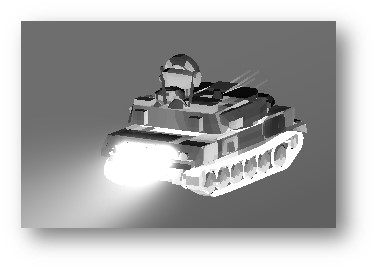

EO/IR Sensor Simulation
Plume Radiation and Signatures
Stealth by Design: High-Fidelity Infrared Signature & Plume Modeling
In the modern defense industry, the thermal signature of a vehicle is critical to its warfighting capability. Plume radiation and signature analysis focuses on the complex infrared (IR) energy emitted by exhaust gases and the resulting thermal interaction with the body of the vehicle. Managing these signatures is vital for survivability, mission success, and regulatory compliance.
ThermoAnalytics’ MuSES addresses these challenges by providing industry-leading capabilities for predicting multi-spectral signatures. By integrating high-fidelity plume modeling with surface thermal physics, we enable engineers to reduce detectability, optimize suppression systems, and ensure sensor performance under diverse environmental conditions.
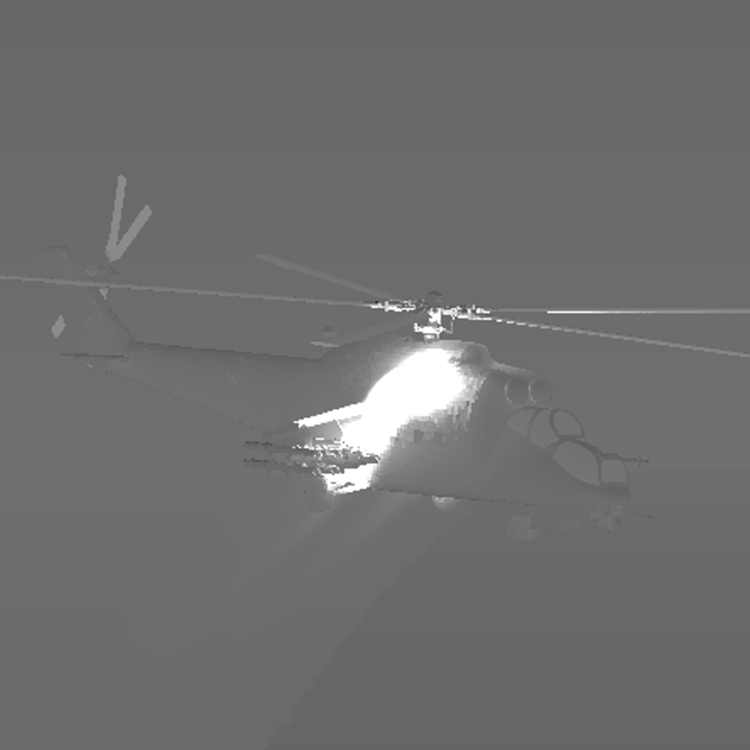
How It Works:
The Physics of Signature Prediction
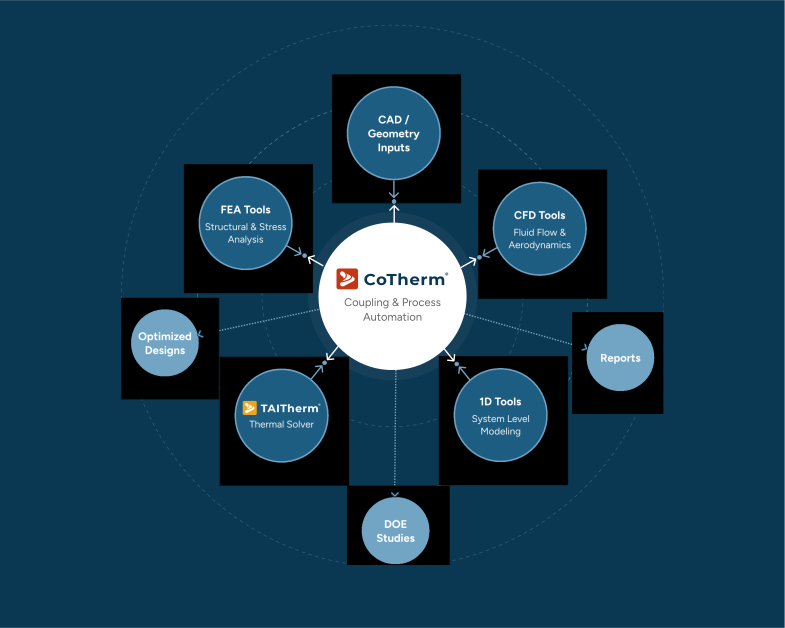
Accurate signature prediction requires a sophisticated multi-physics approach that accounts for both the physical heating of the vehicle and the radiative participation of the exhaust gases. For the most accurate result, our workflow utilizes CoTherm, our process automation software, to manage a pseudo-transient CFD coupling process for modeling plumes and capturing flowfield effects on the hardbody. This ensures the simulation matches real-world spectral measurements through the following integration:

Hardbody Thermal Loading (Convective Coupling)
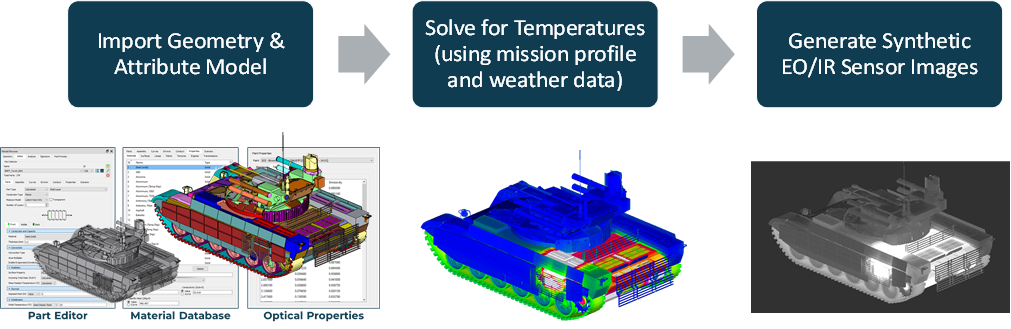
In the first stage, we pull Heat Transfer Coefficients (HTCs) and fluid temperatures from CFD to calculate the physical temperature of the target hardbody over time. This analysis is tied to specific operational parameters, such as engine RPM and exhaust mass flow rate, ensuring the hardbody’s thermal soak and surface radiance are physically accurate.

Plume Volume Voxelization (Radiative Participation)
Once the hardbody temperatures are established, we import the plume flowfield into the signature environment. Here, we take the pressure, temperature, and species concentration (H2O, CO2, soot) and voxelize the plume volume around the hardbody. This allows the software to accurately simulate how the gas volume attenuates or enhances the signal between the sensor and the target.

Atmospheric Integration
Finally, the software simulates the attenuation and path radiance of the atmosphere using MODTRAN, providing a “sensor-at-distance” view of the total IR signature, including the interaction between the heated hardbody and the participating plume media.
Engineering Without Compromise
By integrating ThermoAnalytics into your design workflow, you transform thermal management from a reactive fix into a competitive advantage.
Aircraft Survivability & IRST Reduction
Reducing the Infrared Search and Track (IRST) signature is paramount for military aircraft. Simulation allows engineers to analyze the spatial and spectral distribution of heat from the engine exhaust. By testing different nozzle geometries and cooling bypass ratios in a virtual environment, designers can minimize the “point source” intensity of the plume, significantly increasing the effectiveness of flare countermeasures and stealth capabilities.
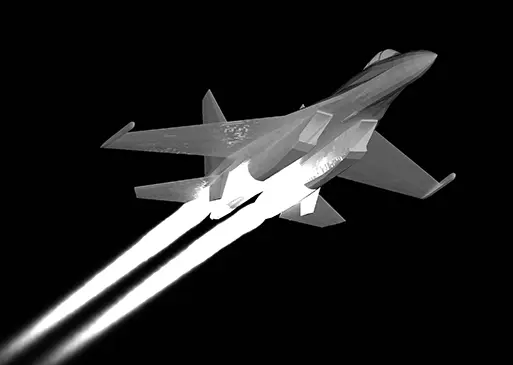
Aerial Plume Interference & Sensor Blinding
For guided munitions, the plume is not just a signature—it is a potential interference source. High-intensity radiation from a jet turbine or missile can “blind” onboard seekers, drastically reducing their effectiveness. Our analysis can predict how a sensor would react to these high intensity plumes and countermeasures, allowing design iterations to be easily and quickly simulated to address these sources of interference.
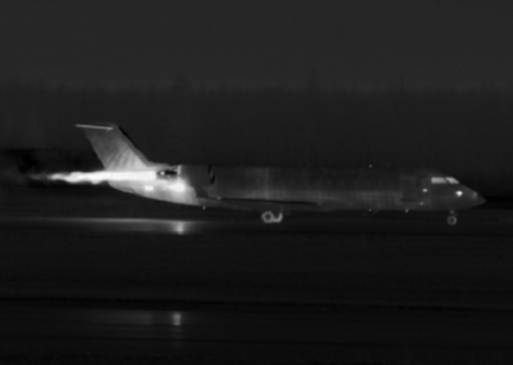
Ground Vehicle Thermal Exhaust Management
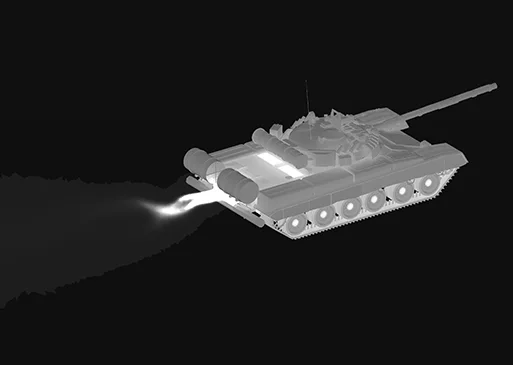
In the context of ground combat vehicles, plumes contribute to the thermal “halo” that makes a vehicle visible to night-vision and thermal imaging. We simulate the mixing of exhaust gases with ambient air to optimize various signature management techniques. This typically reduces the temperature of the exhaust gas before it exits the vehicle, blending the thermal signature into the background clutter of the operating environment.