
EO/IR Sensor Simulation
EOIR Simulation for High-Energy Laser Targeting & Vulnerability Analysis
Analyze Thermal Damage and EO/IR Signatures of Laser Targets
The rapid development and deployment of High-Energy Laser (HEL) and Directed Energy (DE) systems is reshaping modern warfare, introducing new challenges for the survivability of land, sea, and air vehicles. DE weapons can rapidly disable critical components including batteries, fuel tanks, sensors, and electronics, which modern vehicle communication and guidance systems heavily rely on. Integrating HEL systems for field use presents significant engineering challenges. The massive heat flux generated within the compact architecture can degrade performance, as minor thermal gradients can cause optical blooming, component damage, or structural misalignment. Thus, mission success requires a predictive understanding of how these systems impact targets and how effectively they perform under varying operational and environmental conditions.
MuSES is the industry-standard tool for solving these challenges. Its high-fidelity radiation and thermal solver allow engineers to accurately simulate the thermal behavior DE systems and their effects on targets under realistic environmental conditions, including solar loading, atmospheric effects, and complex background interactions. By predicting thermal and IR responses, MuSES enables engineers to identify thermal bottlenecks, reduce signature peaks, and implement mitigation strategies early in the design process. Minimizing costs of prototyping while ensuring the systems and targets remain both functional and discreet in the field.
How It Works:
The Physics of Signature Prediction
The physics of Directed Energy (DE) systems demands a sophisticated approach to transient heat transfer and multi-physics integration. Unlike steady-state applications, MuSES can model DE systems operating in rapid pulses or sustained high-output bursts, providing the capability of tracking thermal capacitance and phase-change effects over time.

Multi-Physics Radiation Exchange
MuSES utilizes a sophisticated ray-tracing engine to account for multi-bounce radiation and specular reflections. In DE applications, this is vital for understanding how “stray light” or thermal emissions from the laser housing impact surrounding sensitive components and the energy distribution on a target surface.

Transient Environmental Coupling
Unlike static thermal models, MuSES accounts for the transient nature of the environment. It calculates the diurnal cycle (changing sun position and environmental conditions) to evaluate how DE system performance and taTransient Environmental Coupling

High-Fidelity Material Modeling
MuSES uses temperature-dependent material properties and directional surface coatings (BRDFs). This allows for an accurate analysis of how both laser system materials and target surfaces absorb, reflect, and dissipate energy, which directly influences the thermal response and infrared signature.

Complex Geometry Handling
The solver is designed to handle intricate geometries, from laser benches and faceted turrets to critical subsystems such as battery packs and electronics, ensuring that conduction through mounts and radiation across internal cavities are captured with high spatial resolution.
Engineering Without Compromise
By integrating ThermoAnalytics into your design workflow, you transform thermal management from a reactive fix into a competitive advantage.
Simulating Laser Energy in MuSES
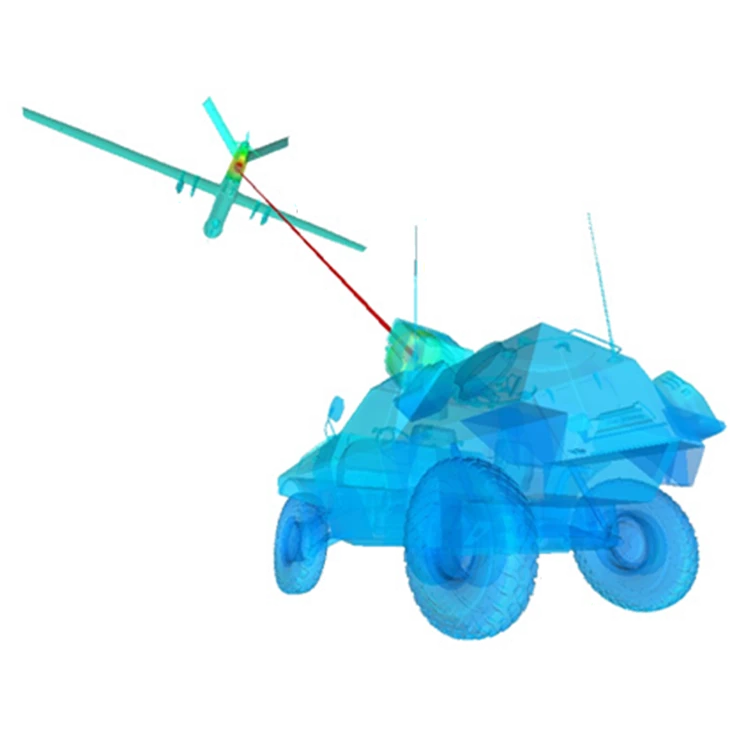
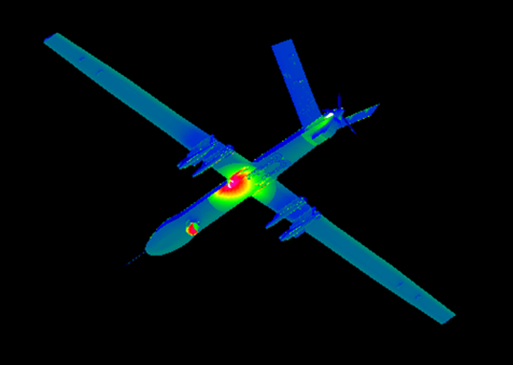
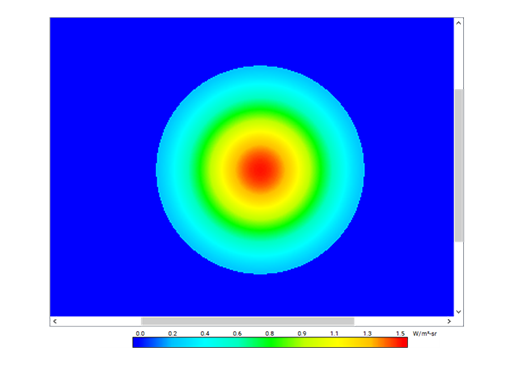
MuSES can accurately model laser energy propagation and its interactions with the environment and targets. User-specified parameters including laser wavelength, source power, beam half angle, and propagation range are used to simulate energy distribution via a Gaussian beam profile with atmospheric attenuation, enabling realistic representation of laser illumination in EO/IR environments. This supports evaluation of detection and tracking performance for Direct Energy weapons, as well as the assessment of covert laser illumination targeting, development of multispectral sensors, and ISR (intelligence, surveillance, and reconnaissance) mission evaluation.
Thermal Management of Power Electronics
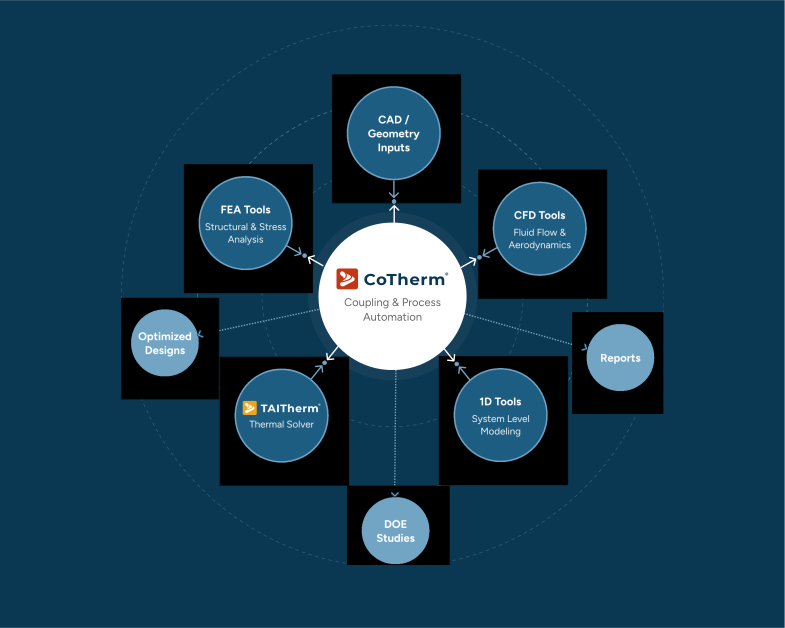
The efficiency and reliability of solid-state electronics, batteries, sensors, and optical systems depend on maintaining proper operating temperatures. Excess heat can degrade performance, reducing light output in beams, limiting battery power delivery, and impairing sensor functionality. Our simulation approach models advanced thermal management systems, including liquid-cooling loops and micro-channel cold plates, to dissipate high heat flux from these densely integrated systems. When paired with CoTherm, MuSES enables rapid evaluation of design iterations by comparing protective material stack ups, layer thicknesses, varying cooling strategies, and component placement. This allows engineers to assess thermal protection performance alongside system tradeoffs such as mass, size, and overall cost.
Target Interaction & Vulnerability Assessment
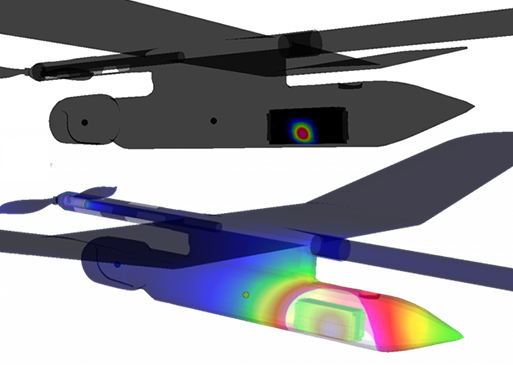
Understanding the effectiveness of a Directed Energy weapon requires modeling the thermal response of the target material. This involves simulating high-intensity energy deposition, material phase changes, and the resulting structural degradation. MuSES allows for the high-fidelity modeling of these interactions, including the target’s infrared signature and the environmental factors that may obscure or diffuse the beam. This end-to-end simulation capability enables defense researchers to quantify weapon lethality and optimize engagement strategies against a variety of emerging threats and cladding materials.