
Thermal Management & Heat Transfer
Exhaust System Thermal Simulation
Master Underbody Thermal Management and Predict Exhaust Radiation
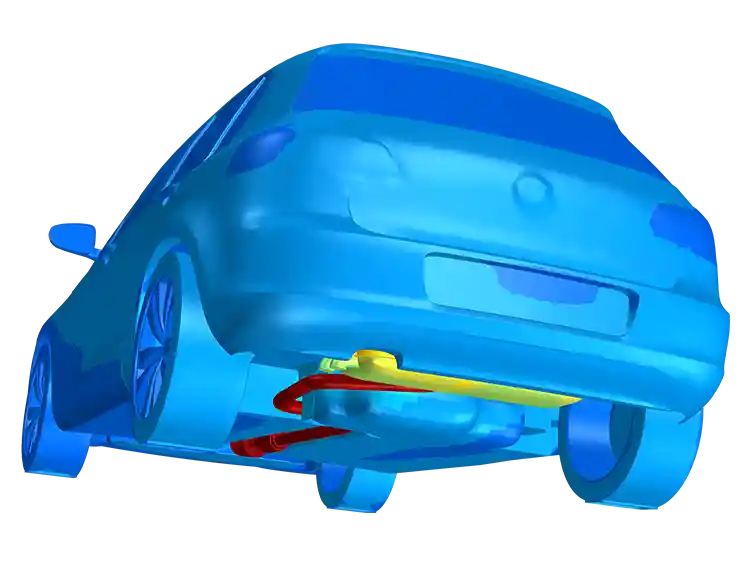
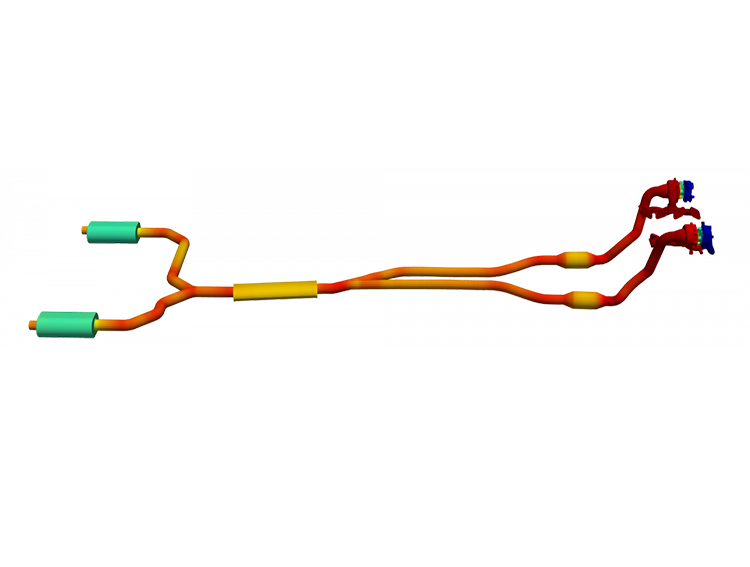
Exhaust systems remain a primary heat source in passenger vehicle underbody and underhood thermal systems, creating one of the most challenging environments for design engineers. ThermoAnalytics’ exhaust stream feature, available in TAITherm, predicts and generates a 1D convection stream based on available 3D geometry. It offers high-resolution results using few inputs and can be set-up in less than 10 minutes. Whether you are managing the thermal footprint of a high-performance internal combustion engine or optimizing the thermal soak of a hybrid, our tools ensure that thermal constraints never limit peak performance.
How It Works:
Multi-Physics Thermal Simulation
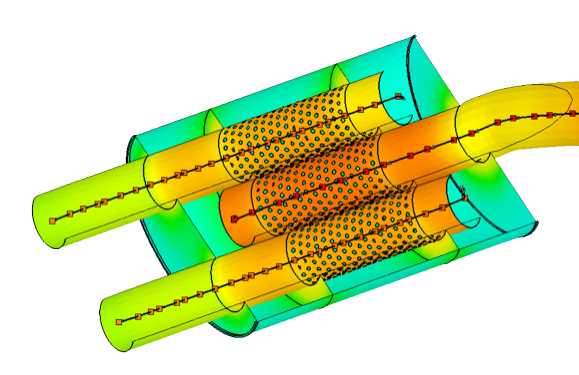
TAITherm’s Exhaust Extension operates as a high-performance plug-in that streamlines the simulation of complex exhaust environments. Unlike traditional static models, our solver utilizes an Exhaust Stream feature to predict and generate a 1D convection stream based directly on your 3D geometry. This advanced thermal solver accounts for critical fluid dynamics, including pulsation, entrance effects, bending, and surface roughness, to ensure convection calculations remain accurate even in highly dynamic scenarios.
By leveraging a library of pre-built components like turbochargers and catalytic converters, engineers can apply specialized physics to their models. The solver integrates these inputs to calculate heat transfer across the system, accounting for conduction through multilayer shields and high-fidelity surface-to-surface radiation. This approach provides a comprehensive view of transient drive cycles and hot soak scenarios, allowing for the rapid optimization of heat protection without compromising on model fidelity.
Engineering Without Compromise
By integrating ThermoAnalytics into your design workflow, you transform thermal management from a reactive fix into a competitive advantage.
Catalyst Thermal Modeling
Predicting the thermal behavior of catalysts is essential for meeting increasingly stringent global emissions standards. By utilizing the exhaust stream part type, engineers can accurately model the thermal mass of the catalyst brick and its response to varying mass flow rates. This analysis allows for the optimization of “light-off” times, the critical window where the catalyst reaches its effective operating temperature, ensuring that the system achieves peak efficiency as quickly as possible during transient drive cycles.
Thermal Stress and Fatigue Life
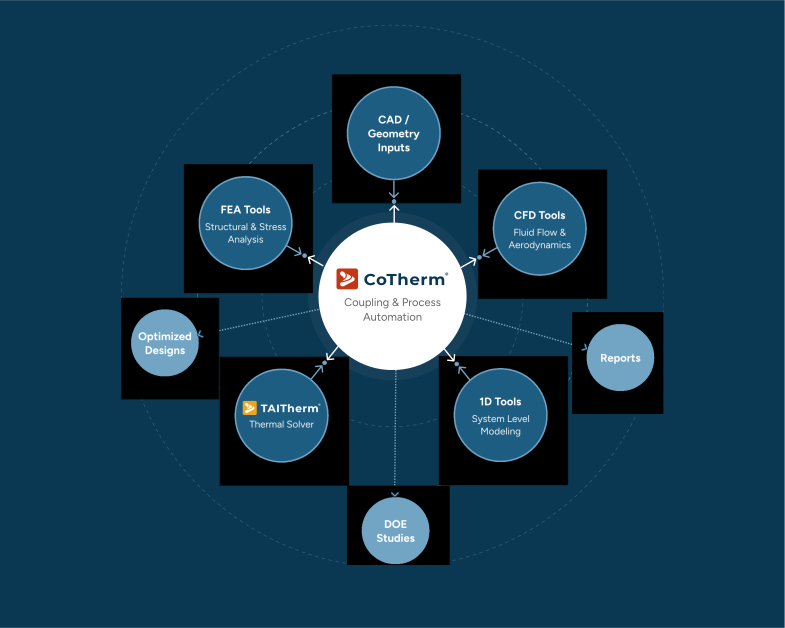
The extreme temperature gradients and rapid cycling found in exhaust manifolds and turbocharger housings lead to significant mechanical strain. Our application allows for the generation of precise, time-dependent temperature maps that serve as the thermal loading input for Finite Element Analysis (FEA). By understanding the transient temperature distribution, designers can predict material fatigue and optimize the thickness and mounting strategies of exhaust components to prevent cracking and structural failure over the vehicle’s lifespan.

Cabin Comfort & HVAC Impact
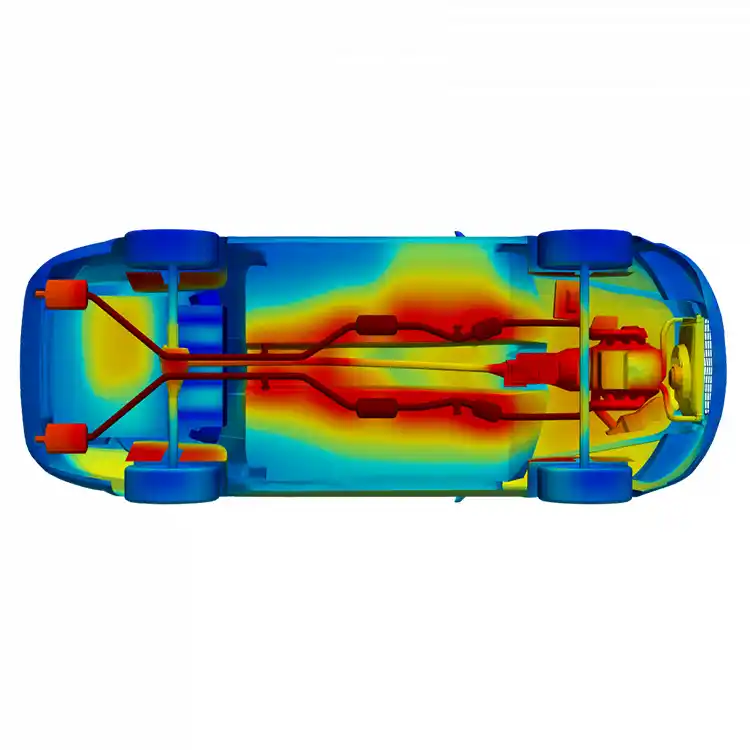
Thermal energy radiating from the exhaust system and mufflers often migrates through the vehicle floor pan, directly impacting the passenger cabin’s climate. Through comprehensive transient analysis, TAITherm quantifies the heat rate into the interior, allowing engineers to evaluate the trade-offs between different insulation materials and air gap thicknesses. This not only improves passenger comfort but also reduces the energy demand on the HVAC system, contributing to better overall fuel economy or electric vehicle range.
view cabin comfort & HVAC