
Fluid Dynamics & Airflow
Building Wind Flow & Architecture, Engineering & Construction Thermal Simulation
From Wind Flow to Occupant Comfort and Building Performance
In the world of Architecture, Engineering, and Construction (AEC), wind is more than just a breeze — it’s a powerful variable that dictates structural integrity, occupant comfort, and energy efficiency. ThermoAnalytics provides the high-fidelity simulation tools necessary to predict how air moves around and through your designs, transforming invisible currents into actionable data.
We bridge the gap between Aero-physics and Human Comfort. While many tools tell you where the wind goes, we tell you how that wind changes the temperature of your building’s glass and how it makes a person standing on the corner feel. It’s not just data; it’s design confidence.
How It Works
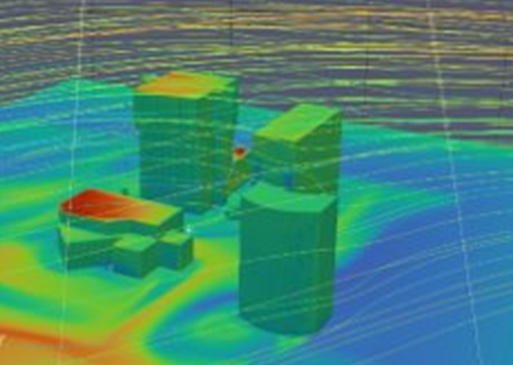
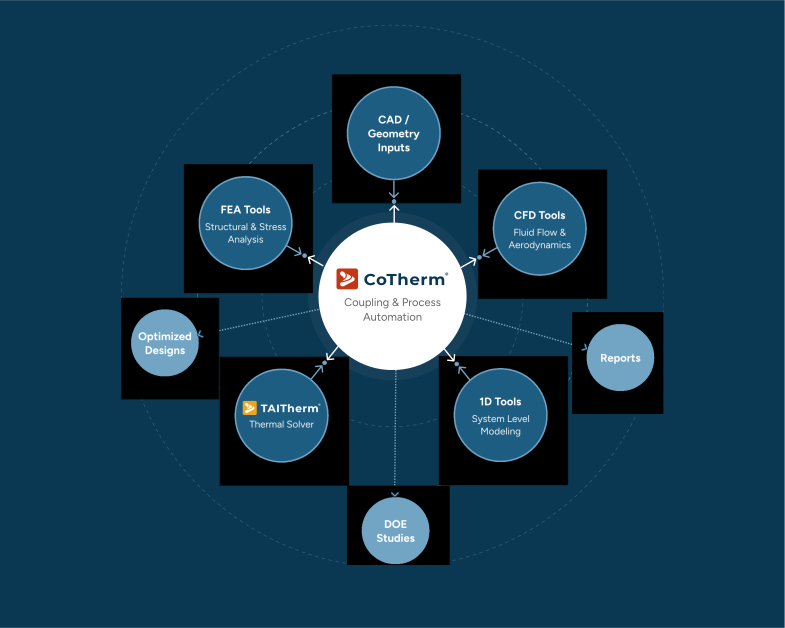
The synergy between TAITherm and RapidFlow creates a powerful, streamlined workflow for AEC simulations, specifically by coupling transient thermal analysis with high-speed fluid dynamics. RapidFlow acts as the specialized CFD engine designed to solve the Navier-Stokes equations for incompressible flow with remarkable speed, allowing users to quickly characterize the wind field and pressure distribution around complex building geometries.
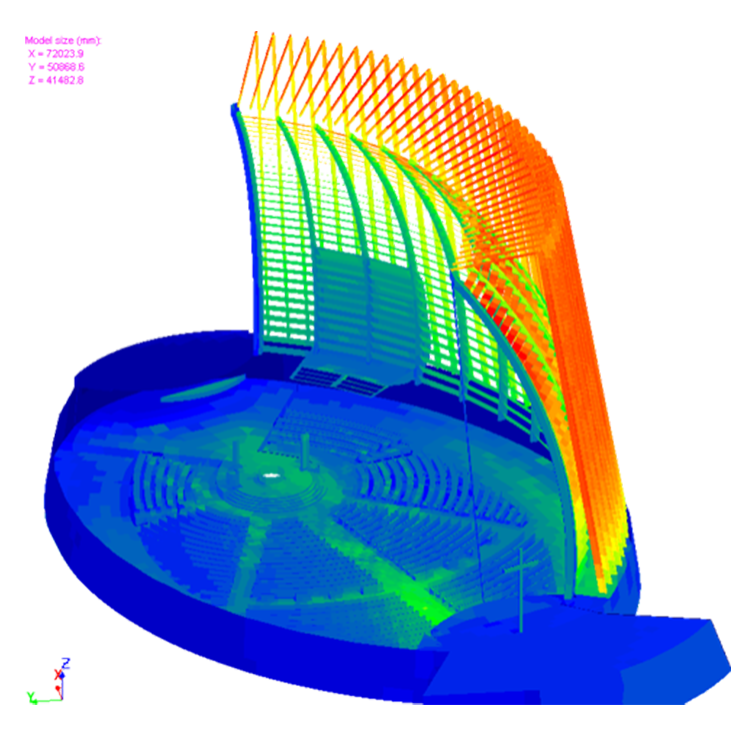
Once the aerodynamic state is established, TAITherm takes over to calculate the full 3D conduction, radiation, and convection heat transfer. The two tools operate in a coupled environment where RapidFlow provides the convective heat transfer coefficients and local air temperatures to TAITherm’s multi-layer surface models. This allows for a “complete” microclimate analysis, accounting for solar loading, material thermal mass, and wind-driven cooling, without the massive computational overhead of traditional, fully coupled transient CFD. The result is a high-fidelity prediction of surface temperatures and human thermal comfort (via the Berkeley Comfort Model) that evolves over time as the sun moves and weather conditions shift.
Engineering Without Compromise
By integrating ThermoAnalytics into your design workflow, you transform thermal management from a reactive fix into a competitive advantage.
Human Comfort Analysis
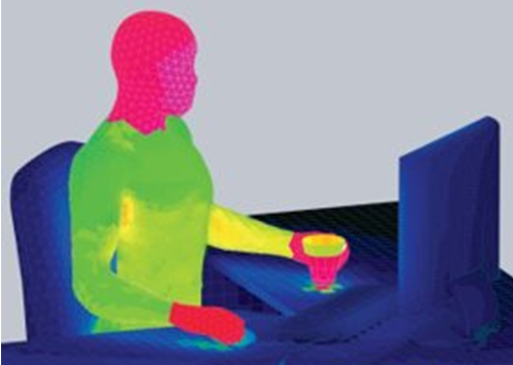
Go beyond simple temperature readings to understand the actual human experience. This feature utilizes the industry-leading Berkeley Comfort Model to simulate the physiological responses of occupants, such as skin temperature, metabolic rate, and clothing insulation, against transient environmental changes. By modeling the human body as a complex thermal system rather than a static point, you can accurately predict comfort levels in both indoor spaces and outdoor urban plazas, ensuring designs meet the highest standards for occupant well-being.
Environmental Effects Analysis
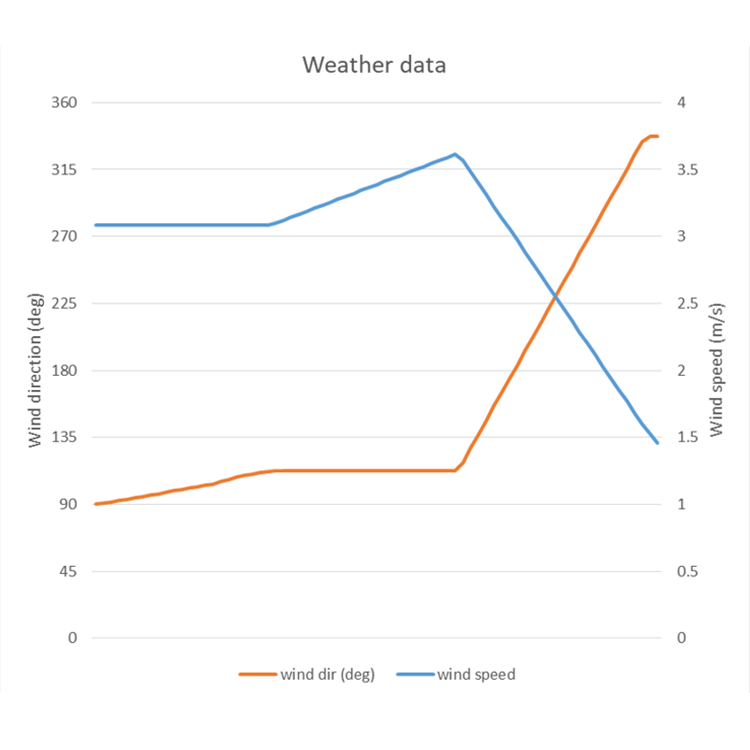
Achieve true-to-life accuracy by placing your design in a high-fidelity virtual world. This feature leverages extensive meteorological libraries to simulate real-world weather patterns, including precise calculations for direct, diffuse, and reflected solar radiation. By accounting for diurnal cycles and local wind profiles, you can generate highly accurate energy usage predictions and assess the impact of environmental stressors on building materials and HVAC performance over any period of time.

Workflow Efficiency
Engineered to eliminate the bottlenecks of traditional CFD, our toolset prioritizes rapid deployment without sacrificing accuracy. With automated Cartesian meshing and an intuitive interface, engineers can move from raw CAD data to a running simulation in as little as 10 minutes. This streamlined approach minimizes the manual burden of mesh refinement and boundary condition setup, allowing your team to focus on iterating designs and making data-driven decisions rather than managing complex software overhead.